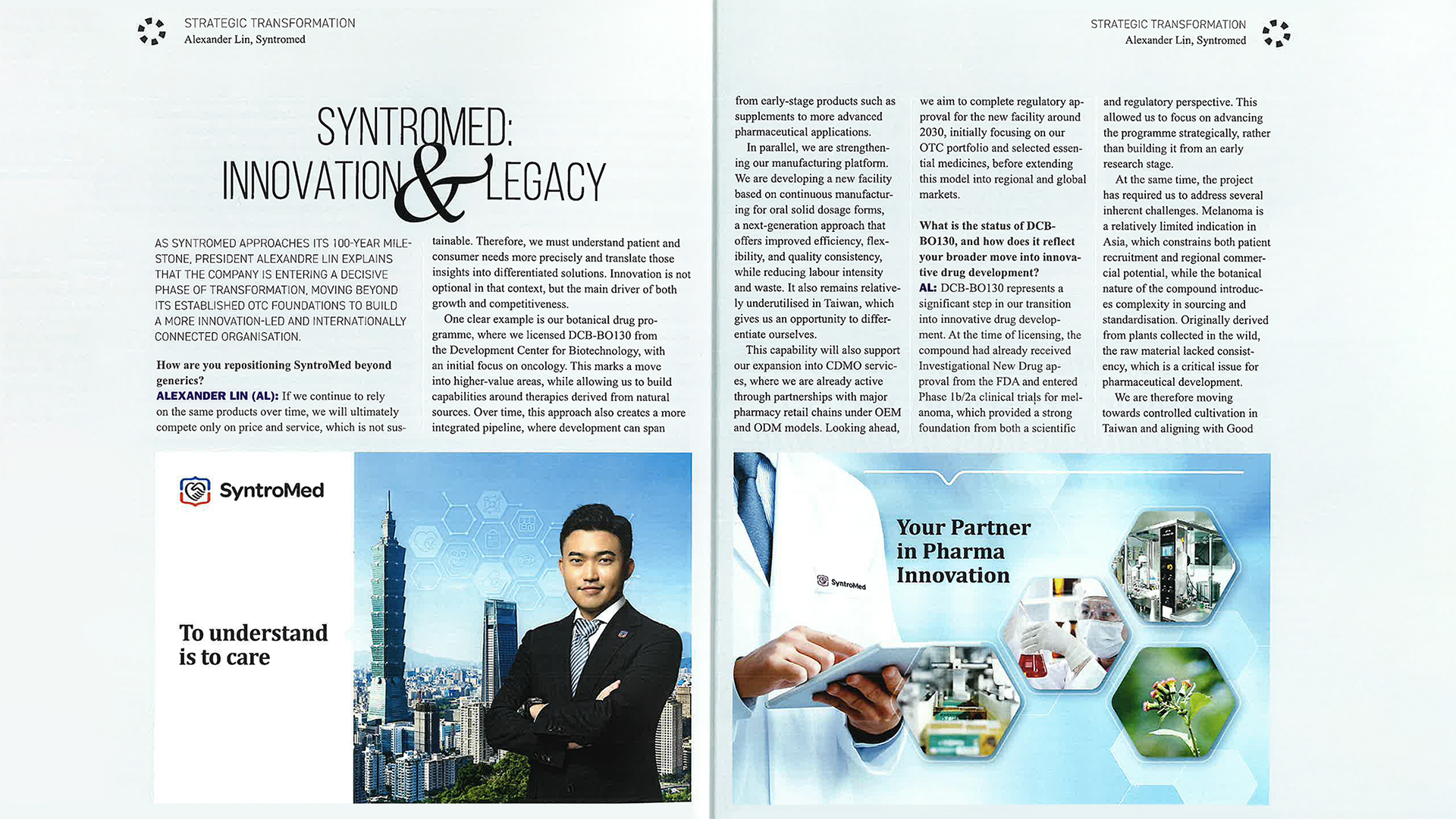
As SyntroMed approaches its 100-year milestone, the company is entering a decisive phase of transformation, moving beyond its established OTC foundations to build a more innovation-led and internationally connected organisation. As Dr Alexander Lin explains, from botanical oncology programmes to advanced manufacturing and a partnership-driven expansion across Asia-Pacific, the strategy reflects a clear shift towards higher-value growth while responding to evolving healthcare needs and policy priorities. At the centre of this transition lies a disciplined effort to balance scale, innovation, and purpose, positioning SyntroMed for its next chapter on the global stage.
What has shaped your professional journey, and how does it inform SyntroMed’s repositioning as a more internationally oriented organisation?
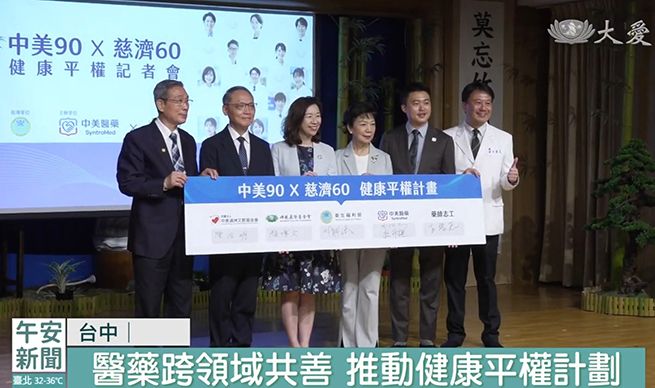
I joined Chung Mei Pharmaceutical Group in 2013, and we are now rebranding under the name SyntroMed while retaining our original Chinese name as part of our heritage. Founded in 1936, we have built a strong presence in Taiwan’s over-the-counter (OTC) market, but as we expanded beyond Taiwan, it became increasingly clear that a more distinct global identity was needed. In several Southeast Asian markets, our Chinese name created confusion, with some stakeholders assuming we were a mainland Chinese company, which in turn affected perceptions of quality. The SyntroMed name addresses this directly, supporting our international positioning while remaining anchored in our history. The timing also aligns with our 90th anniversary in 2026, making it a natural point to refresh both our brand and our direction.
My academic and professional path has been shaped by exposure to both Taiwan and the United States. I began in microbiology at National Taiwan University before pursuing graduate studies in biochemistry at the University of Southern California, where I gained a broader perspective on scientific research and international collaboration. I started my career at Parexel, which provided early insight into global drug development and regulatory processes, and later joined Phenomenex in Los Angeles. There, I worked across Asia-Pacific markets, particularly Greater China, combining scientific understanding with commercial execution across diverse markets.
Although I had initially planned to continue building my career overseas, I returned to Taiwan to join the family business and contribute to its next phase of development. I assumed the role of chairman in 2022 following my father’s passing, becoming the fourth-generation leader. That transition reinforced a key realisation: while we hold a strong position in Taiwan’s OTC segment, the domestic market alone is not sufficient to support long-term growth. Historically, we operated with a largely local focus, supported by long-standing partnerships, particularly with Japanese pharmaceutical companies, which helped establish a solid foundation.
As the industry becomes more global and regulatory expectations continue to rise, scale, diversification, and international reach have become increasingly important. We have therefore expanded our presence across the Asia-Pacific region, working through distribution partnerships in Southeast Asia, Hong Kong, Macau, and China, while continuing to collaborate with partners in Japan, Korea, Canada and Europe. This evolution reflects a broader shift from a domestically focused OTC business towards a more regionally integrated healthcare platform, with SyntroMed representing a clearer, more outward-looking identity aligned with that ambition.
Where do you see the main drivers of growth emerging over the next five years, and how are you evolving beyond your traditional OTC base?
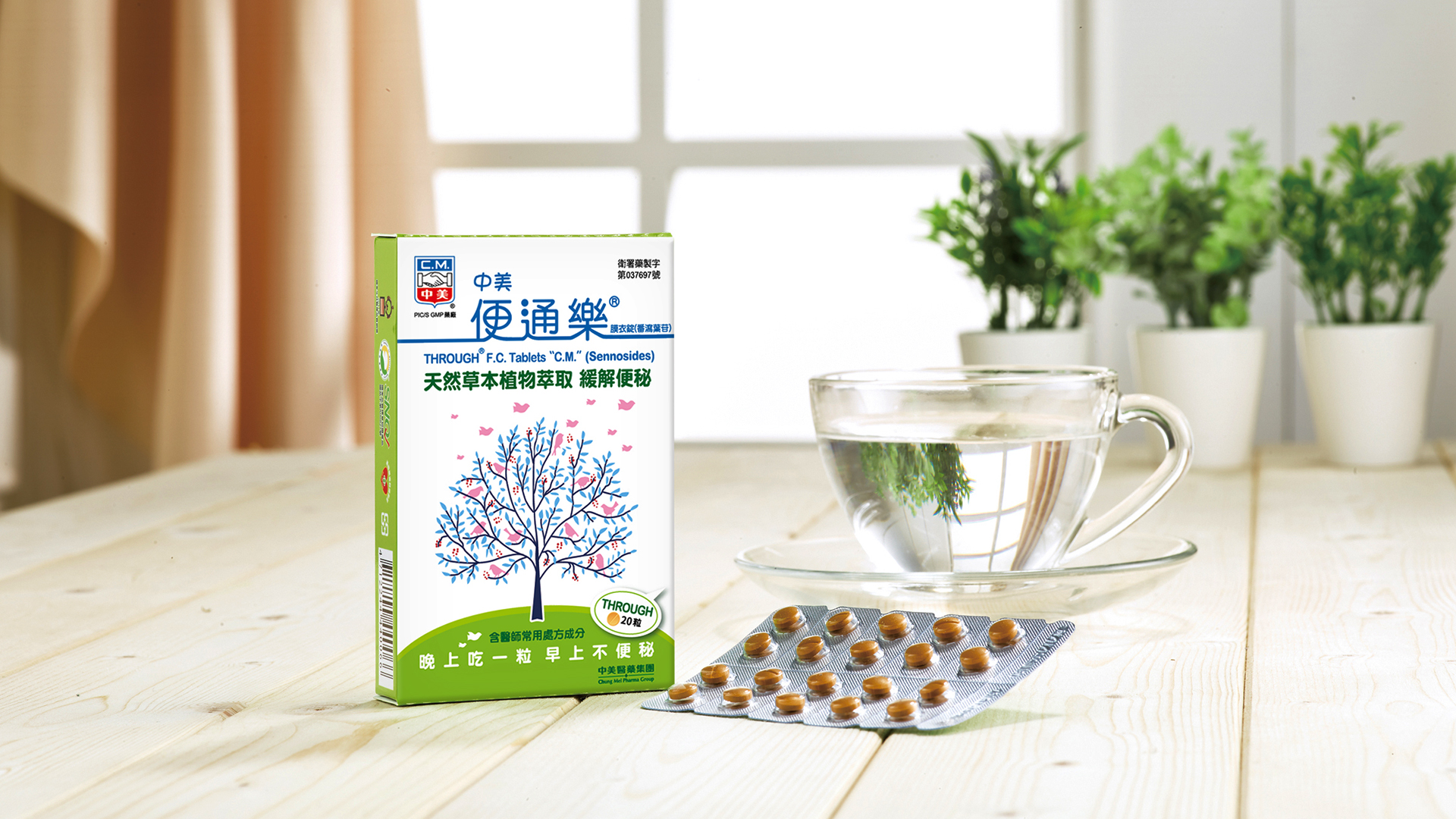
In Taiwan, our OTC business continues to provide a strong and stable foundation, supported by established brand recognition and broad pharmacy coverage, but the priority today is how we build on that base rather than rely on it. The traditional model, largely centred on generics and replication, inevitably leads to price-driven competition, which is not sustainable in the long term. We are therefore moving towards a more consumer-driven approach to product development, using structured feedback to identify unmet needs and design targeted solutions. This is already shaping our expansion into areas such as cholesterol management and preventive health, while also allowing us to extend into adjacent categories, including health supplements and selected medical devices, often through collaboration with external partners.
At the same time, we are gradually extending beyond OTC into more clinically oriented segments, where we see both demand and room for differentiation. Our ongoing discussions around continuous glucose monitoring illustrate this direction, as they would enable us to enter diabetes management and broader chronic care. More broadly, we are focused on bringing differentiated products into Taiwan through carefully selected partnerships, particularly in areas where patient demand is growing but the market remains underdeveloped. In parallel, we are strengthening our position in prescription medicines through collaborations such as our work with Pharmascience, where we aim not only to register products locally but also, over time, to explore the localisation of manufacturing.
This strategic shift is reinforced by changes in the policy environment. For many years, domestic pharmaceutical companies were not a primary focus, as supply was largely stable and supported by imports. However, the COVID-19 pandemic exposed structural vulnerabilities in global supply chains and prompted a reassessment of these assumptions. The Taiwanese government has since introduced a pharmaceutical resilience programme, to strengthen domestic manufacturing capacity and secure the supply of essential medicines. This creates a meaningful opportunity for us to move beyond commercialisation and play a more active role in local production and supply.
From our perspective, this also highlights the value of combining local insight with international reach. Having operated in Taiwan for decades, we have a detailed understanding of patient and healthcare system needs, while our growing network of global partners allows us to bring in products and capabilities that can be adapted efficiently to the local market. This positions us to respond more effectively to both policy priorities and evolving patient demand, while contributing to a more resilient healthcare ecosystem.
Looking ahead, we are also exploring adjacent areas such as animal health, particularly in companion animals, where demand for more advanced care continues to grow across Asia. While still an emerging area for us, it reflects a broader strategy of building multiple, complementary revenue streams over time. Overall, our approach is to retain the strength of our OTC foundation while progressively expanding into higher-value segments, supported by a combination of consumer-focused innovation, targeted partnerships, and deeper integration into Taiwan’s evolving healthcare landscape.
How are you repositioning SyntroMed beyond generics, and what role do innovation and advanced manufacturing play in sustaining long-term competitiveness?
At its core, our strategy is grounded in a simple but necessary shift: if we continue to rely on the same products over time, we will ultimately compete only on price and service, which is not sustainable. The focus therefore has to be on understanding patient and consumer needs more precisely and translating those insights into differentiated solutions. Innovation is not optional in that context, but the main driver of both growth and competitiveness, and it is where we have deliberately increased our investment since I joined.
One clear example is our botanical drug programme, where we licensed DCB-BO130 from the Development Center for Biotechnology, with an initial focus on oncology. This marks a move beyond traditional generics into higher-value areas, while allowing us to build capabilities around therapies derived from natural sources. Over time, this approach also creates a more integrated pipeline, where development can span from early-stage products such as supplements to more advanced pharmaceutical applications, shifting the business away from replication towards value creation.
In parallel, we are strengthening our manufacturing platform as a strategic differentiator. We are developing a new facility based on continuous manufacturing for oral solid dosage forms, working with technology partners in Europe. This model is increasingly recognised as a next-generation approach, offering improved efficiency, flexibility, and quality consistency, while reducing labour intensity and waste. It also remains relatively underutilised in Taiwan, which gives us an opportunity to differentiate ourselves not through scale alone, but through the way we produce.
This capability will also support our expansion into contract development and manufacturing organisation services, where we are already active through partnerships with major pharmacy retail chains such as Matsumoto Kiyoshi under original equipment and original design manufacturing models. Looking ahead, we aim to complete regulatory approval for the new facility around 2030, initially focusing on our OTC portfolio and selected essential medicines aligned with Taiwan’s resilience agenda, before extending this model into regional markets and, over time, further afield.
What is the current status of DCB-BO130, and how does it reflect your broader move into innovative drug development?
DCB-BO130, which we licensed from Taiwan’s Development Center for Biotechnology, represents a significant step in our transition beyond OTC and generics into innovative drug development. At the time of licensing, the compound had already received Investigational New Drug approval from the FDA and entered Phase 1b/2a clinical trials for melanoma, which provided a strong foundation from both a scientific and regulatory perspective. This allowed us to focus on advancing the programme strategically, rather than building it from an early research stage.
At the same time, the project has required us to address several inherent challenges. Melanoma is a relatively limited indication in Asia, which constrains both patient recruitment and regional commercial potential, while the botanical nature of the compound introduces complexity in sourcing and standardisation. Originally derived from plants collected in the wild, the raw material lacked consistency, which is a critical issue for pharmaceutical development. We are therefore moving towards controlled cultivation in Taiwan and aligning with Good Agricultural and Collection Practices (GACP) to ensure a stable and standardised supply. In parallel, we are repositioning the clinical strategy towards colorectal cancer, which is significantly more prevalent in Asia, and are preparing a new IND submission in the United States, with early-phase clinical work expected to begin in Taiwan before expanding into broader, multi-country studies.
More broadly, DCB-BO130 reflects how we are approaching innovation as a long-term capability rather than a single asset. It brings together clinical development, supply chain control, and strategic positioning, while also underlining the importance of international partnerships for later-stage development and commercialisation. As the programme evolves, we also see potential to expand into additional indications, supported by early observations suggesting immune-related mechanisms, which could further extend its clinical and commercial relevance.
How do you position SyntroMed as a partner of choice, and what types of collaborations are you prioritising as you expand internationally?
Partnerships are a central pillar of how we operate and grow, and we typically engage across three complementary areas. For companies seeking to enter Taiwan, we offer strong local execution, particularly in OTC but also across clinical and hospital channels, where we combine market understanding with regulatory experience. At the same time, we can support partners internationally by supplying high-quality OTC products into their markets, leveraging our manufacturing and development capabilities. Beyond this, we are increasingly focused on technology-driven collaborations, where we help partners adapt and register products for Taiwan, recognising that approvals in markets such as Japan do not automatically translate to compliance with Taiwan Food and Drug Administration (TFDA) requirements, and often require adjustments in formulation, documentation, or manufacturing processes.
This approach allows us to move beyond a purely commercial role and act as a bridge between markets, combining local insight with technical and regulatory capabilities. In practice, this means supporting partners not only in distribution, but also in navigating regulatory pathways and refining products to meet local standards, which can significantly improve the efficiency of market entry. These types of collaborations are particularly relevant for companies with differentiated products or technologies that require localisation before they can be successfully introduced.
From an international perspective, our near-term focus remains on Asia-Pacific, where we already have a presence and a stronger understanding of market dynamics. We will continue to expand across Southeast Asia and Greater China, while also exploring opportunities to transition from importing into markets such as Japan and Korea towards more outward-facing partnerships. At the same time, we remain open to opportunities in Europe and other regions, while in the United States we are still at a planning stage, with a partnership-led approach centred on supporting our pipeline development before considering a more formal presence.
As you look ahead, what kind of organisation are you aiming to build, and how would you define the legacy of this next phase of development?
We are approaching a critical stage in our development, moving from a 90-year legacy towards our centenary, and the focus now is on ensuring that we evolve beyond a strong domestic foundation into a more regional and ultimately global organisation. Over the next five to ten years, this means building a more structured company with clearer governance, broader international exposure, and the scale required to compete in a more demanding environment. As part of that trajectory, we are preparing for a potential public listing on the Taiwan Exchange around 2030 or 2031, which we see as a natural step in strengthening the organisation and supporting its next phase of growth.
At the same time, this transformation needs to remain grounded in the philosophy that has guided us since our founding in 1936, namely that medicine is not simply a commercial activity, but a responsibility. For me, this is closely linked to maintaining a strong focus on patients and consumers, and ensuring that what we develop, whether in OTC or prescription products, addresses real and unmet needs in a meaningful way. Growth and internationalisation are important, but they need to be supported by a clear sense of purpose and consistency in how we operate.
In terms of legacy, my responsibility is to leave behind an organisation that is stronger, more internationally connected, and better prepared for the future, regardless of who leads it next. Whether the next generation chooses to join should depend on their own interests and capabilities, but if they do, they should inherit a company with a solid position across Asia-Pacific, growing global relevance, and the foundation of a listed business. Ultimately, what matters is not only the scale we achieve, but our ability to remain consistent in delivering high-quality products that genuinely improve patients’ lives.